
Fight Jewish Exceptionalism
Anti-Zionists need to attack Israel as they would any other settler colonial ethnostate. This means treating Jews equally rather than as sacrosanct.

Israel proclaims itself as the representative state of “the Jewish people”, which carries out its actions to further their interests. This idea is foundational to its legitimacy in the West. The logic goes like this:
Israel is Jewish,
There is something uniquely special and legitimising about Jewishness,
Therefore we must support Israel, even if it acts in ways that we would usually oppose.
The standard response to this in Western pro-Palestine activism for many decades has been to contest the idea that Israel represents Jews: we spotlight anti-Zionist Jews and go to pains trying to argue that Israel is itself antisemitic for framing ‘Jews as a monolith’, etc.
It isn’t an exaggeration to say that talking points like these have been some of the most oft-repeated refrains among anti-Zionists, perhaps even the most repeated. (Notably, such discussions are much less common in anti-Zionist circles outside of the West, including among Palestinians themselves.)
But this approach has achieved nothing. Worse, it’s been quite detrimental—something that’s corroborated by the complete failure of the Western anti-Zionist movement to achieve anything of consequence at all.
It accepts the premise of the claim rather than attacking it, reinforcing Zionist narratives in doing so.
There is nothing uniquely special and legitimising about Jewishness. But these standard Western anti-Zionist tactics accept the notion, tacitly or otherwise, that there is.
Israel is inherently illegitimate due to its very nature, as a settler colonial project based on the replacement of the indigenous people and their society with a new society run by and for those considered to be a part of its settler in-group. In this case, that in-group happens to be Jews, but this does not meaningfully change anything about the dynamic. It would be the same if Palestine had been colonised by Aymara, or Filipinos, or Serbians, or Mormons, or any other group.
Thus, discussions about the identity of the settlers are wholly irrelevant. At best, they are distractions. At worst, they lead us into accepting the core premise of pro-Israel propaganda: the notion that Jews are exceptional, and that there is some special value in appealing to their wants, their needs, and to having some of them on our side.
And that is precisely what anti-Zionists often do when engaging with this premise. Paradoxically, some of the most prominent and visible people in the Western pro-Palestine movement tend to be Jews. Some of the most prominent organizations tend to be specifically Jewish. And this is not mere happenstance: they embrace Jewish exceptionalism, flaunting their Jewishness at every opportunity. This is not only rarely ever questioned as a strategy by others in the movement, but it’s actually outright embraced.
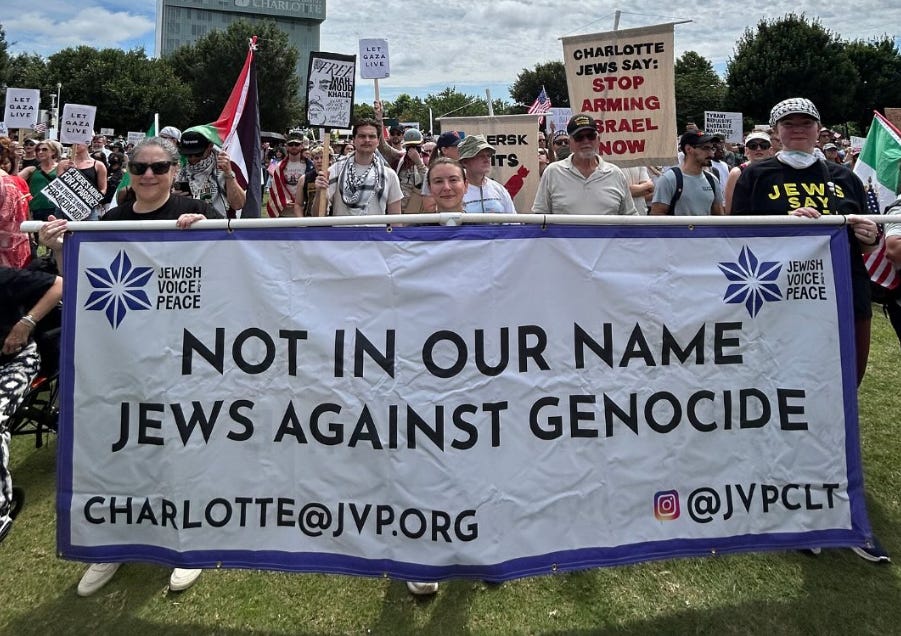
It’s time to not only question this, but abandon it entirely. We need to attack Jewish exceptionalism at its very core by diffusing the absurd notion that anything about a group’s identity should change how we approach their project to invade another people’s land, destroy their society, and replace it with a new society for their own benefit—not reinforce that notion by focusing our messaging on the idea that Israel doesn’t actually represent the ‘special’ group of people in question.
Israel would be illegitimate whether it had the support of 100% of Jews, 50% of them, or 10% of them. No group of people gets to hold a vote amongst themselves on whether or not they can do settler colonialism. But the implication of this line of argumentation, whether those making it mean for it to be taken this way or not, is that Jews do. By arguing along these lines, we imagine ourselves to be diffusing Israeli propaganda, but we are actually accepting one of its core foundations.
When the problems with this sort of strategy are brought up, one of the most common retorts is that, due to the prevalence of this sort of Jewish exceptionalism in the West, it’s useful to convince people to turn against Israel: people think that Jews are special, that there is something uniquely legitimising about Jewishness, that being anti-Israel is anti-Semitic, and so we have potential allies to gain by arguing that Israel doesn’t actually represent Jews.
But this is a lazy shortcut: it’s as detrimental as it would be to argue against race science by not contesting its premise that some ‘races’ are superior to others, and instead arguing that this still doesn’t justify taking rights away from the ‘inferior’ ones. Even if you manage to convince people that you’re right, you still haven’t fixed the root problem at all, and the potential for disaster further down the road, due to you leaving the the problem of people believing that some races are superior to others unaddressed, is going to be immense.
The same is true here: an anti-Zionist movement full of people who are left to believe that there is something uniquely special about Jewishness is a recipe for disaster. The root problem is with the premise itself. Everything else stems from it, and anything but attacking it head-on can only ever be a band-aid fix.
It may be more difficult to convince people that Jews aren’t special and that Jewish opinion on Jewish supremacist colonialism doesn’t matter in the first place, than it is to simply point to a token Jew with a ‘Not In My Name’ t-shirt. But it is absolutely required if we are going to create effective anti-Zionist advocates rather than just inadvertedly lead more people into liberal Zionism. Which leads in to the next point.
It pushes people into going soft on Zionism.
The Jewish exceptionalist premise is based on the idea that Jews are uniquely oppressed and perenially in danger, to the point that it’s practically innate to them. This unique oppression thus warrants unique exceptions afforded to them, which legitimises Israel’s otherwise very unsavoury nature and actions.
Anyone who holds Jewish exceptionalist sympathies is thus primed to be manipulated into liberal Zionist ideas & solutions, and primed to be sympathetic to Israelis when working towards the best outcomes for Palestinians is often going to require us to have much harder hearts. If one believes that there is something special about Jews in this way, then when the time comes to take coercive actions that are sure to harm Israeli Jews and hurt the feelings of their Jewish supporters abroad, we will not be able to count on their support.
It’s easy to claim to support BDS when it’s not being done at scale yet, but will you be able to withstand the inevitable attempts at emotional manipulation if sanctions and blockades are ever truly imposed upon Israel? Will you falter when you hear about how much this is harming (gasp!) Jewish Israelis?
When the time comes to evict the Israeli settlers from the West Bank, will you laugh in the face of those framing it as an ethnic cleansing of poor, vulnerable, innately oppressed Jews and a Second Holocaust?
It’s doubtful that those who hold on to Jewish exceptionalism will be able to. It’s much more likely that they will turn against their own movement.
The reality of the situation is that Israel itself is full of Jews who would sooner die than give up the racial privileges they enjoy at the expense of the Palestinian people. And—as I will be elaborating on later in this article—they are supported in this endeavour by the vast majority of Jews worldwide. Any potential future that involves anything resembling just outcomes for the Palestinian people will involve a lot of coercive force against people who happen to be Jewish, and the propaganda against this will, as always, be entirely based around the supposed uniqueness, specialness, and innate vulnerability of Jews. If we uphold Jewish exceptionalism, it will work on us. Or worse: we won’t even get there in the first place, as Jewish exceptionalism primes people to abandon anti-Zionism and become liberal Zionists at the first sign of any real conflict with the interests of Jewish people. It’s easier to support liberation in the abstract rather than in reality, where it’s often very messy and necessitates that people among the oppressor group be harmed in some way.
We got a taste of this already on October 7th, 2023. The Jewish exceptionalist groups who dominate the Western pro-Palestine movement did not meet the moment, instead allowing themselves to be pressured into making both-sides statements, denouncing the resistance and expressing their horror at the suffering of the poor, innocent, Jewish, Israeli settler-victims, with scarcely even a fight.
It redirects the discussion away from what is actually happening and to whom.
So much of what’s called “Pro-Palestine activism” in the West isn’t actually that at all. It is instead discussions/arguments about things like:
Does Israel represent all Jews?
Is anti-Zionism anti-Semitism?
Do Israel’s actions cause anti-Semitism?
Is Israel harming Judaism?
Does Israel act in line with Jewish values and traditions?
Is Israel itself anti-Semitic?
What can we do to fight anti-Semitism?
Is the specific phrasing that some pro-Palestine person used anti-Semitic if you squint a little bit and look at it from a 90 degree angle at 3pm on a Friday?
The problem is that absolutely none of this has anything at all to do with the Palestinian anti-colonial struggle. It doesn’t matter to Palestinians if Israel represents all Jews, or if Israel represents Jewish values, or if Israel’s actions make some American Jew feel ashamed of being Jewish, or whether there’s anti-Semitism in some other country.
The equation for them remains exactly the same: they are fighting a genocidal, settler colonial ethnonationalist project that wants them eliminated or expelled. How they fight this should remain the same regardless of the specific identity of those carrying it out. But those of us in the West who uphold Jewish exceptionalism spend so much time and effort focused on these completely useless arguments centred entirely around the oppressor group, that, rather than being good and useful allies to the Palestinian people, we actually make it harder for them to fight as they need to be able to in many respects.
The Palestinian writer Mohammed El-Kurd described the effect that this sort of anti-activism has on Palestinians themselves in his article “Jewish settlers stole my house. It’s not my fault they’re Jewish”:
I learned about Hitler and the Holocaust, I learned about the nose stereotype, the poisoned wells, the bankers, the vampires, the snakes and the lizards (I just found out about the octopus), and I learned that, when speaking to diplomats visiting our zoo of a neighborhood, the settlers squatting in our home must be the secondary point of my presentation, second to an effusive denunciation of global antisemitism. And when my 80-something grandmother addressed those foreign visitors, I corrected her mid-sentence whenever she described the Jewish settlers in our house as, well, Jewish.
We have helped to foster a semantic environment where Palestinians themselves, rather than focusing on their own struggle in the way they need to be able to, are instead often forced into focusing on their oppressors and acknowledging their imagined victimhood, before they are even allowed to point to the oppression. Palestinians are, ludicrously, themselves framed as potential or actual victimisers of a supposedly vulnerable population, when that population is actively oppressing them. Jewish exceptionalism is the only reason why such an immensely stupid notion is taken seriously. It’s time that we change our habits and challenge these circumstances rather than perpetuating them.
It is not our job to do PR for the Jewish community, or to make sure we’re regulating our rhetoric to not hurt any Jewish feelings, or to ‘fight anti-Semitism’. Our job is to help free Palestine. If Jewish Anti-Zionists want to talk about these sorts of questions, they are free to do so within their own communities, where they are actually relevant. But it is well past time that they stop hijacking the pro-Palestine movement and making it about themselves.
It is factually incorrect.
There is also a simple factual problem with these sorts of arguments, though this is secondary to the main issues outlined above. Most Jews do actually support the state of Israel and consider it to be core to their Jewish identity. In Israel itself, it goes without saying that this is the case, as the genocidal consensus in Israeli society is well known. Around 50% of Jews in the world are Israeli, so that is already a huge part of the global Jewish population.
And in the West, Zionism dominates the Jewish community. In the UK, 77% of Jews feel attached to Israel, 88% regard it as their ancestral homeland, and 65% outright identify as Zionists. In Australia, 88% of Jews feel a close personal connection to Israel, and 86% believe that the existence of Israel is essential for the future of the Jewish people.
Even in the U.S., which probably has the least Zionist Jewish community in the West, things are still decidedly Zionist: 76% believe that Israel’s existence is vital for the Jewish people. That’s 3 in 4.
While no global polls exist, if we count Israeli Jews and non-Israeli Jews together, worldwide support for Zionism among Jewish individuals is easily around 90%. Zionism is an innately genocidal, settler colonial, ethnic supremacist ideology, based around harming the indigenous people of Palestine and its neighbouring nations for the benefit of supposedly ‘superior’ Jews. These are the same core logics of Nazism. So, regardless of how confronting such a statement may be to some readers, that means that around 90% of Jewish individuals are essentially the modern-day equivalent of Nazis.
Institutionally, things are much worse. Nearly all Jewish community and religious institutions are openly supportive of Israel, and most are even material participants in Israeli colonialism: recruiting settlers, donating to Israel, and in many cases, even sending their congregants to Israel to join the military, which can only be described as entirely legal recruiting for terrorism. The situation is much worse than even what the most delusional Islamophobes imagined about Muslim support for terrorism when ISIS was at its height.
So if your argument is based around any implication, no matter how slight, that Jewish opinion for or against Israel could ever be what legitimises it—as the ‘not in my name’ line of argument unavoidably does—then you are essentially making an argument against your own anti-Zionist position, as Jews worldwide overwhelmingly support the existence of Israel as a Jewish supremacist ethnostate.
On the notion of innate and ongoing ‘unique’ Jewish oppression.
A lot has changed since 1945. The Jewish community is no longer marginalized. Jews are fully accepted in mainstream Western society—if anything, they are now economically and socially advantaged. Jewish institutions are exceptionally well funded and organised, and very good at pushing what they consider to be their community’s interests (which most of the time is just Zionism).
Far from being a persecuted minority, they are, if anything, uniquely catered to. Issues brought forward by the Jewish community are given huge levels of attention relative to population. Politicians, far from being the anti-Semitic crusaders who were endemic in Western politics in the late 19th and early 20th centuries, are now overwhelmingly much more concerned with crusading against ‘anti-Semitism’, which is treated as the most serious and urgent form of racism, far above all others, in spite of how utterly ridiculous of a notion that now is. It’s also defined so broadly as to encompass basically anything that could ever hurt a Jewish person’s feelings even slightly: since most Jews support Israel, this of course includes people saying anything negative about Israel. Such is the level of coddling from mainstream society that the Jewish community now enjoys.
You could argue that these politicians, and Western society at large, don’t genuinely care about Jewish issues, and rather just find it convenient that Jewish support for Israel happens to align with their foreign policy interests. But ultimately, the reasoning doesn’t matter, as the situation remains the same regardless: the image that most people have in their head, of the average Jew being a concentration camp inmate in a striped jumpsuit, is so far from reality today as to be ridiculous.
The average Jewish person is now infinitely more likely to be phoning your employer and trying to get you fired for saying you don’t like Israel than they are ever facing anything resembling actual oppression.
Anti-Zionists need to stop treating Jews like some sort of sacred cow and align their beliefs much more with the actually existing circumstances of the present day, where half the Jews in the world live in an ethnostate that is explicitly designed to benefit them at the cost of others, and most of the other half are very well-off, relatively politically influential supporters of that same ethnostate. The only thing that stops anti-Semitism from being as unserious of a prejudice as anti-white racism today are the fringe right-wing crazies who occassionally attack Jews.
But that does not even remotely approximate the actual systemic prejudice and oppression still faced by other groups. The level of attention that it’s given is completely out of line with the level of attention it warrants. This is very intentional: the point is to make anti-Semitism out to be much worse than it actually is, to instill and strengthen the idea of Jewish exceptionalism that we’re discussing here in the psyche of the public for pro-Israel propaganda purposes. This is why there are hundreds of Jewish organisations all over the world that are dedicated to counting so-called ‘anti-Semitic incidents’, a practice that does not exist even remotely on such a scale for any other form of prejudice due to the lack of a similar background political motive. As I demonstrated in my video dissecting the evidence for the alleged ‘Global anti-Semitism crisis’, it is a pro-Israel moral panic rather than a materially existing reality.
Conclusion
Anti-Zionists should not police themselves in ways that other movements against analogous cases of settler colonial genocide would not. The way that we have focused so much on Jewish people and their supposed problems for decades now makes about as much sense as it would have for an abolitionist to have been focused on prejudice against white people as much or more than they were on slavery.
That Israel happens to be a Jewish supremacist state rather than one for some other ethnic or religious group must not be allowed to change anything for us, regardless of the strength and prevalence of the propaganda demanding that it does. That we have allowed it to affect us to such a great degree has been a serious failure, and if we don’t take conscious action to change this, we will just continue to fail to even be able to diagnose the problem, let alone work towards its solution.
Zionism, in all of its variations, in an unacceptable Jewish supremacist ideology, and Israel is the manifestation of its Jewish supremacist tenets in practice. We must free ourselves from the limitations imposed upon us by the notion that there’s anything special or different about Zionism just because it’s for Jews, and that requires challenging Jewish exceptionalism at its premise, rather than taking lazy shortcuts that reinforce it. Because Jewish exceptionalism can only have power over those who believe that Jews are exceptional.
Thanks for reading. If you like my Substack content, consider checking me out on YouTube, on my Main channel and my Second channel.
And consider supporting me financially on Patreon, or making a one time donation on Ko-Fi.
Thanks again for your support!
Great post. I’ve done a full compilation of multiple surveys of Jews’ opinion of Israel around the world including the US, Israel, Canada, UK, France, and Australia. The results are exactly what you would expect and extremely consistent: https://tariqacknickulous.substack.com/p/yes-most-jews-are-in-fact-zionists
It infuriates me seeing Western politicians morally grandstand over "antisemitism" yet in their same breath actively spew out truly genocidal rhetoric against Muslims, Hispanics, and Black people. It's sickening